
Data Centers

Why the sudden need for all these massive data centers? Whose data are they storing and why? Why are the negative impacts on local populations being ignored?
Data centers are massive buildings full of computers and require as much electricity and cooling water as a small city. Yet, they provide almost no jobs for the local economy.
Even Orwell couldn't imagine the system currently being put in place. Tyrannical governments require massive surveillance. Massive surveillance generates massive data. Massive data requires massive data centers. Artificial Intelligence is required to manage and process massive quantities of data.
This is what is driving AI development. They aren't spending trillions on AI just so people can generate an image of a girl with three tits. AI will be the core of the Mark of the Beast surveillance system. Digital currency will provide the control network. One click of a bureaucratic mouse and you can no longer buy or sell.
I live 30 miles south of nowhere and they are building two large data centers on farmland within 30 miles of me. What the hell is going on?
There are currently over 4000 large-scale data centers in the US. There are approximately 450 large-scale data center sites currently under active construction.
The U.S. remains the nucleus of the data center boom, holding nearly 70% of the world's capacity currently under construction. So, the US has 4% of the global population and 50% of the existing data centers, and is building 70% of the global expansion. This US expansion is projected to require up to $7 trillion in total spending by 2030.
Do you really think that the government is spending trillions of dollars just to track your porn search history?
Anything else would require years of environmental impact studies, dozens of permits, etc. But not data centers. Those buildings are going up faster than the price of groceries and gasoline.
Data centers pose significant environmental and community drawbacks, including massive water usage for cooling (up to 5 million gallons daily for large facilities) and high electricity demands that can strain local grids and increase resident energy bills. They cause noise/light pollution, require significant land, and generate e-waste.
Data centers consume immense amounts of electricity, with some facilities requiring up to 2 megawatts (MW) — equivalent to 2,000 homes. They also require millions of gallons of water annually for cooling, which can strain local water supplies, particularly in drought-prone areas.
Noise and Pollution: Diesel-powered backup generators, which are frequently tested, produce significant air pollution and noise. Data centers also create light pollution.
Limited Local Economic Benefits: While they provide jobs during construction, long-term employment is relatively low compared to the large size of the facilities. Furthermore, tax breaks given to attract them can reduce revenue for local schools and services.
Land Use Conflicts: Large data centers require massive amounts of land, often encroaching on residential or agricultural space.
So, what is a “data center”?
A data center is a secure, physical facility that houses IT infrastructure—such as servers, storage systems, and networking equipment—to store, process, and distribute massive amounts of data and applications. They act as the backbone of the digital economy, powering cloud computing, AI, and daily internet activities by ensuring high-speed connectivity and data redundancy.
Key Functions of a Data Center:
Data Storage and Management: They hold data, ranging from company files to cloud-based user photos, using massive arrays of servers.
Processing Power: Data centers provide the computing power required for complex tasks like AI, machine learning, and big data analytics.
Networking and Connectivity: They utilize routers, switches, and firewalls to connect internal systems to the internet and ensure secure data transmission.
Reliability and Security: Modern centers offer redundant power, cooling, and security to prevent downtime and protect against data loss.
Types of Data Centers:
Enterprise Data Centers: Built and managed by a company for its own use.
Colocation Data Centers (Colos): Facilities where organizations rent space, power, and cooling to house their own servers.
Cloud Data Centers: Third-party providers (like AWS, Microsoft Azure) offering computing infrastructure as a service.
Edge Data Centers: Small, decentralized facilities located close to users to reduce latency for high-speed apps.
Data centers allow businesses to achieve "economies of scale," reducing the costs of managing, powering, and cooling IT infrastructure compared to maintaining private, onsite server rooms.
The sudden and massive surge in data center demand is primarily fueled by a generational investment supercycle in digital infrastructure. While the internet has always required servers, the current "explosion" is driven by four major shifts in how we use and process inforinformation.
1. The Generative AI "Race"
The most significant driver is the rapid rise of Generative AI. Unlike standard cloud services, AI models require specialized, high-density hardware (like GPUs) that consumes up to 50 times more power than traditional server racks.
Training vs. Inference: Initially, centers were needed to train massive models like ChatGPT. Now, the demand is shifting toward inference—the ongoing process of these models actually answering user queries in real-time, which requires widespread, permanent infrastructure.
Workload Surge: AI is projected to make up 70% of all data center workloads by 2030, up from just 25% in 2025.
2. High-Performance Computing (HPC) & Big Data
Modern business and research now rely on massive datasets for real-time analytics, precision agriculture, and autonomous systems.
Data Gravity: As companies collect more information, they need larger on-site storage and stronger "east-west" bandwidth (data moving between servers within the same center) to process it without delays.
5G and Edge Computing: The rollout of 5G and IoT (Internet of Things) devices requires smaller "edge" data centers located physically closer to users to ensure near-zero lag for things like self-driving cars.
3. National Security and Economic Strategy
Data centers are now viewed as critical national infrastructure.
The AI Race: Governments are racing to build domestic capacity to ensure they don't fall behind in the "AI industrial revolution." In the U.S., these facilities are being designated as vital for national security and economic growth.
Data Sovereignty: Many regions, particularly Europe, are implementing strict laws that require citizens' data to be stored and processed within their own borders, forcing tech companies to build local facilities.
4. Consolidation and Economies of Scale
It is often more cost-effective for companies to move their data into massive "hyperscale" or colocation facilities rather than maintaining their own small server rooms.
Efficiency: Large-scale centers can better manage the extreme cooling and power needs required for modern chips, achieving lower costs per megawatt than smaller, private setups.
Supply Chain Front-Loading: Fear of future shortages has led some companies to "front-load" their demand, leasing and building capacity years before they actually need it to secure their spot on the power grid.
Look up how far you are from the nearest data center…
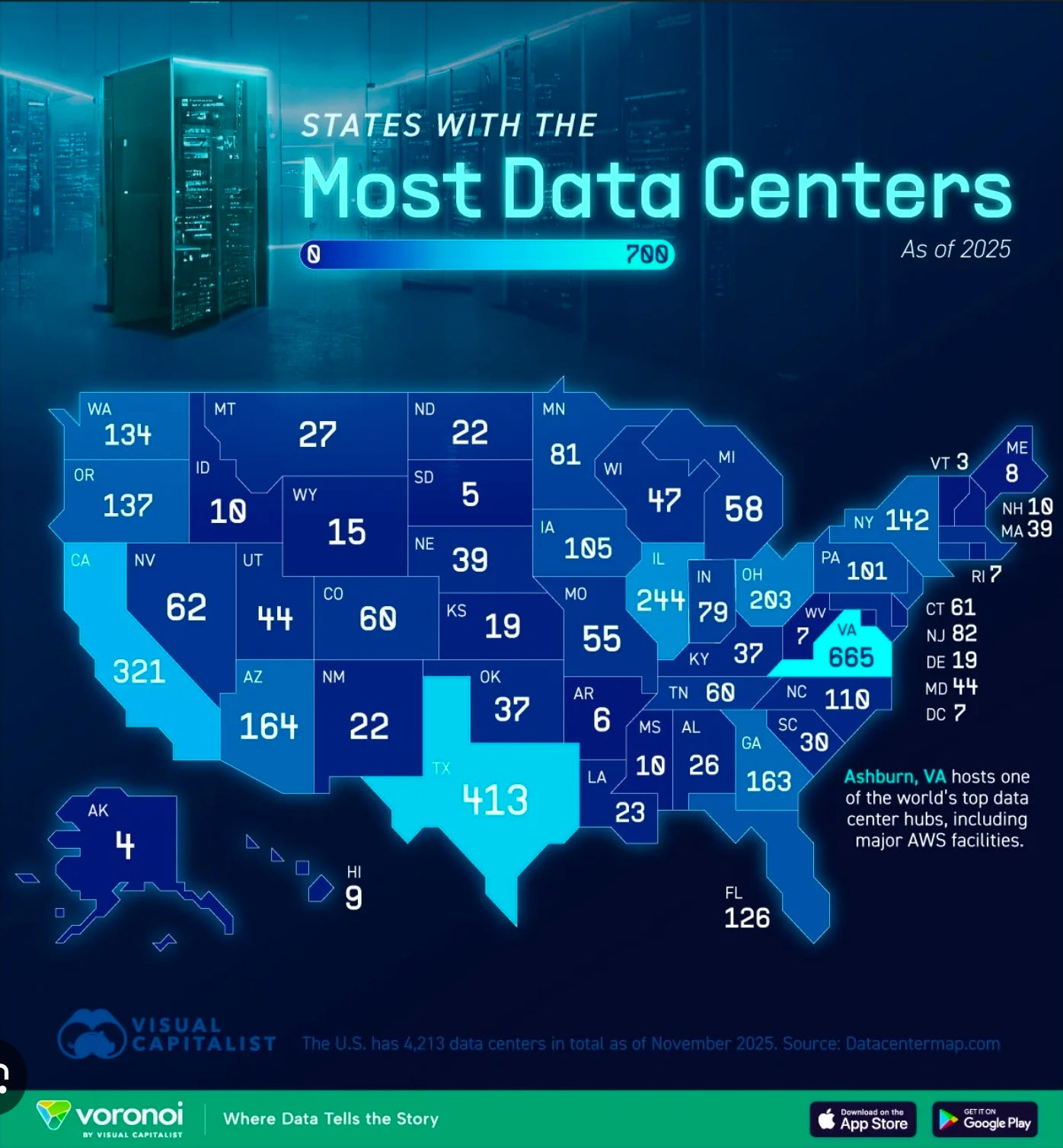
Is there an accurate map of existing data centers and an accurate location guide to those being built? If so, please post this.
Here in KY, they are continually breaking ground off a major interstate towards Louisville building these data centers. While the map only reflects 37, I can guarantee there will be many more by end of year.