
X37B

The X-37B was designed and built by Boeing Phantom Works in Huntington Beach, CA. The X-37B's classified nature has sparked significant controversy, with much speculation about its true purposes beyond official statements of technology testing.
Introduction to the X-37B Program
The Boeing X-37B, also known as the Orbital Test Vehicle (OTV), is a reusable, unmanned spaceplane developed for the United States Department of Defense (DoD).
It represents a significant advancement in reusable space technology, serving as an experimental platform for testing advanced systems in orbit. The program emphasizes risk reduction, experimentation, and the development of operational concepts for long-duration space missions.
Two X-37B vehicles have been acknowled to have been built, and as of February 2026, the program has completed eight missions (OTV-1 through OTV-8), accumulating over 4,208 days in space across its flights.
These missions have progressively extended endurance records, with the most recent ones incorporating novel maneuvers and expanded capabilities. The X-37B is managed by the U.S. Space Force's Air Force Rapid Capabilities Office (AFRCO) in partnership with NASA and the Air Force Research Laboratory, with Boeing as the prime contractor.
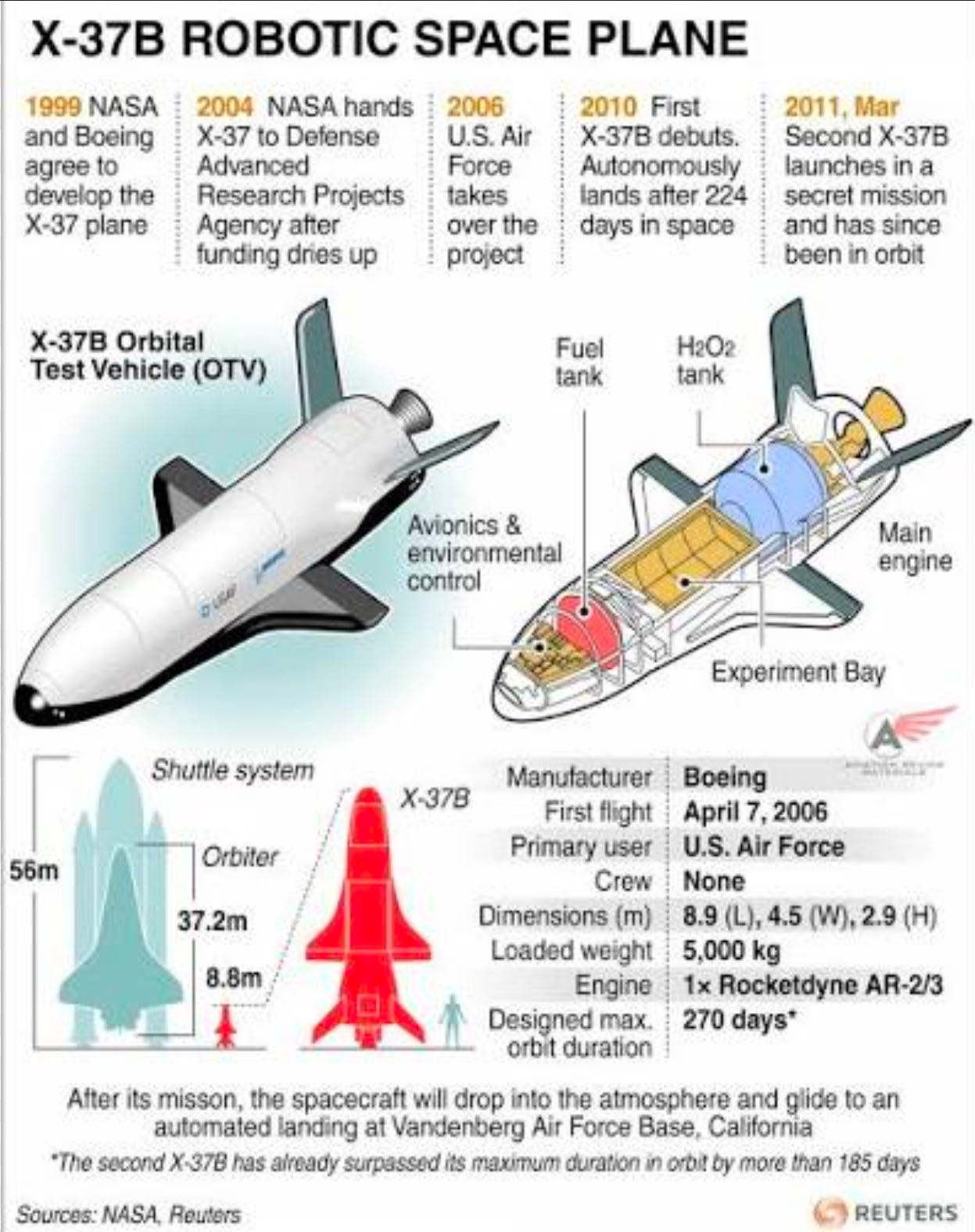
The X-37B program's origins trace back to 1999, when NASA selected Boeing Integrated Defense Systems to design and develop an orbital vehicle as part of efforts to advance reusable space technologies.
The project was a scaled-up derivative (120% larger) of the earlier Boeing X-40 experimental vehicle, initially funded with $192 million, including contributions from NASA ($109 million), the U.S. Air Force ($16 million), and Boeing ($67 million). In late 2002, Boeing received an additional $301 million contract under NASA's Space Launch Initiative.
The program shifted focus in September 2004 when it was transferred from NASA to the Defense Advanced Research Projects Agency (DARPA), becoming classified due to its potential military applications.
This move was influenced by post-Challenger disaster policies aiming for independent U.S. space access. By November 2006, the U.S. Air Force announced the X-37B variant, building on DARPA, NASA, and Air Force efforts.
Development emphasized extended orbital stays (initially up to 270 days), autonomous reentry, and lightweight structures. Glide testing began in 2005 with the X-37A Approach and Landing Test Vehicle (ALTV), which conducted captive-carry and free-flight tests from the Scaled Composites White Knight aircraft, validating flight dynamics before relocating to Air Force Plant 42 in Palmdale, California. The AFRCO has managed the program since 2010, focusing on advancing reusable capabilities for the Space Force.
Construction and Design
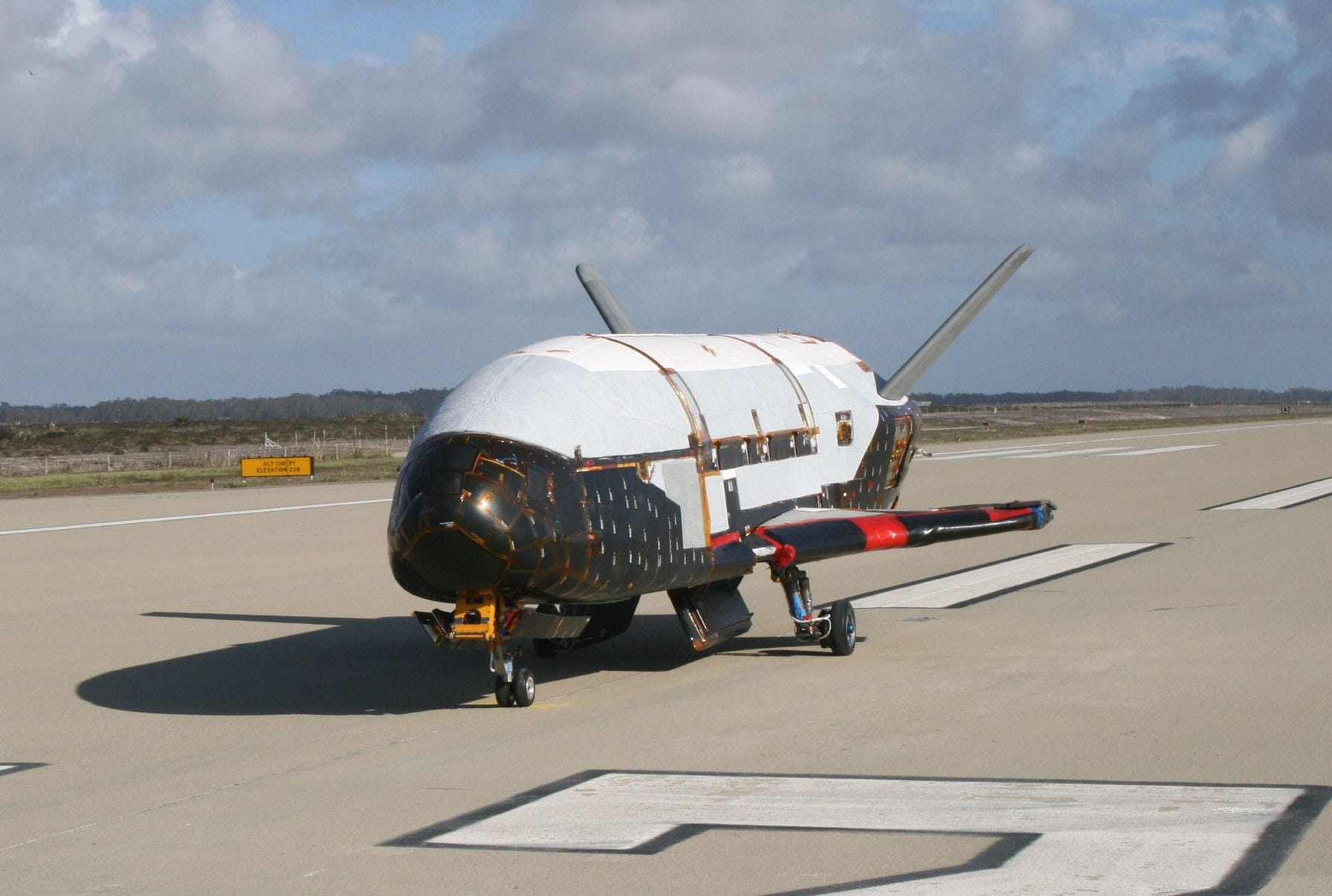
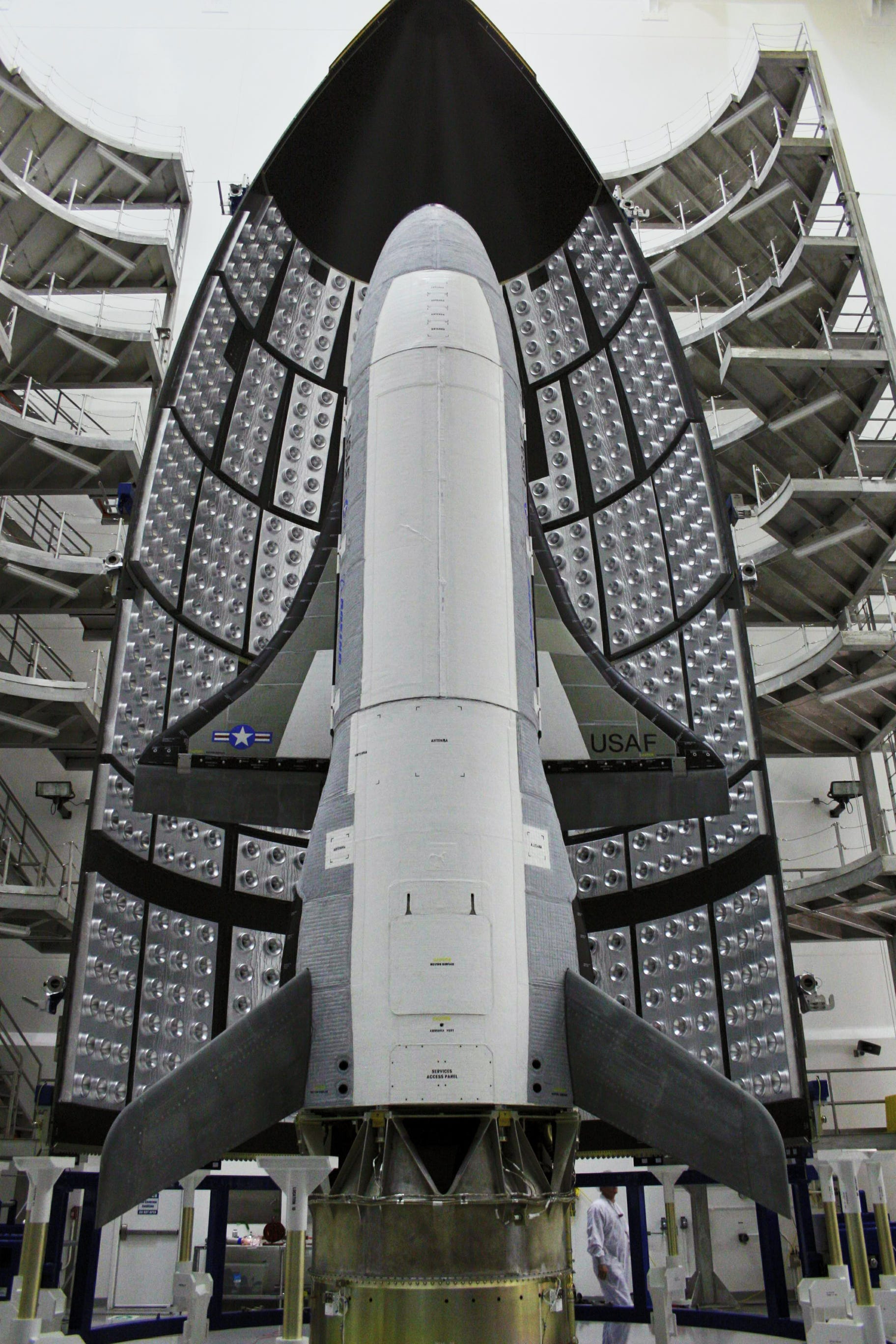
The X-37B was constructed by Boeing's Phantom Works division in California, with two operational vehicles produced. It is a compact spaceplane, measuring over 29 feet (8.8 meters) long, with a wingspan of about 15 feet (4.6 meters) and a launch mass of approximately 11,000 pounds (5,000 kg)—making it roughly one-quarter the size of the Space Shuttle orbiter.
The design features two angled tail fins, an advanced airframe, enhanced avionics, and autonomous guidance systems. Its thermal protection system uses improved silica ceramic tiles for reentry speeds up to Mach 25.
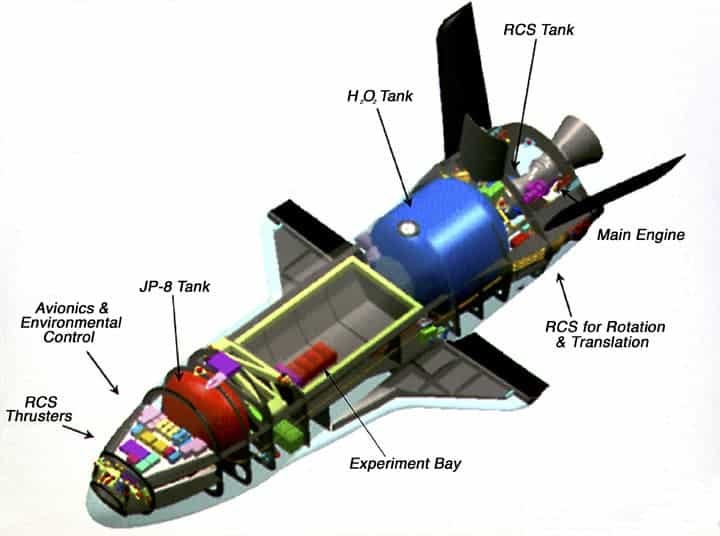
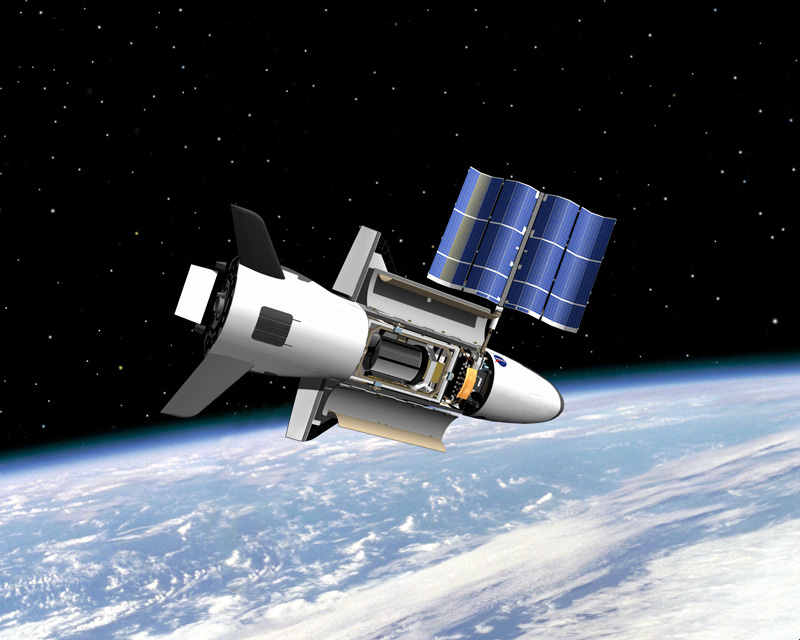
Power comes from gallium arsenide solar cells and lithium-ion batteries, with a payload bay measuring 7 by 4 feet (2.1 by 1.2 meters) capable of carrying up to 500 pounds (227 kg) of experiments. Early propulsion relied on an Aerojet AR2-3 engine using hydrogen peroxide and JP-8 fuel, but this was later upgraded to hypergolic nitrogen tetroxide and hydrazine for better performance.
The vehicle was redesigned from an initial Space Shuttle cargo bay concept to accommodate shrouded rocket launches due to cost and aerodynamic concerns. It can land autonomously on runways, a capability shared only with the Soviet Buran and Space Shuttle (though the latter's auto-landing was untested in crewed flights).
Upgrades over time include fault protection, autonomy enhancements, and collision avoidance systems, as seen in recent missions.
Launch Methods and History
The X-37B is launched vertically atop expendable rockets and returns horizontally like an aircraft. Primary launch vehicles include the United Launch Alliance Atlas V 501 (used for OTV-1 through OTV-4 and OTV-6), SpaceX Falcon 9 (OTV-5 and OTV-8), and Falcon Heavy (OTV-7).
Launches occur from Cape Canaveral Space Launch Complex 41 or Kennedy Space Center Launch Complex 39A. Pre-launch processing happens in Orbiter Processing Facilities at Kennedy, followed by fairing encapsulation for transport.
The first mission, OTV-1, launched on April 22, 2010, from an Atlas V and lasted 224 days, landing at Vandenberg Space Force Base. Subsequent missions extended durations: OTV-2 (468 days, 2011), OTV-3 (674 days, 2012), OTV-4 (717 days, 2015, first Kennedy landing), OTV-5 (779 days, 2017), OTV-6 (908 days, 2020), OTV-7 (launched December 28, 2023, ongoing as of early 2025 with 434 days by mission end, but extended operations noted), and OTV-8 (launched August 22, 2025, on Falcon 9).
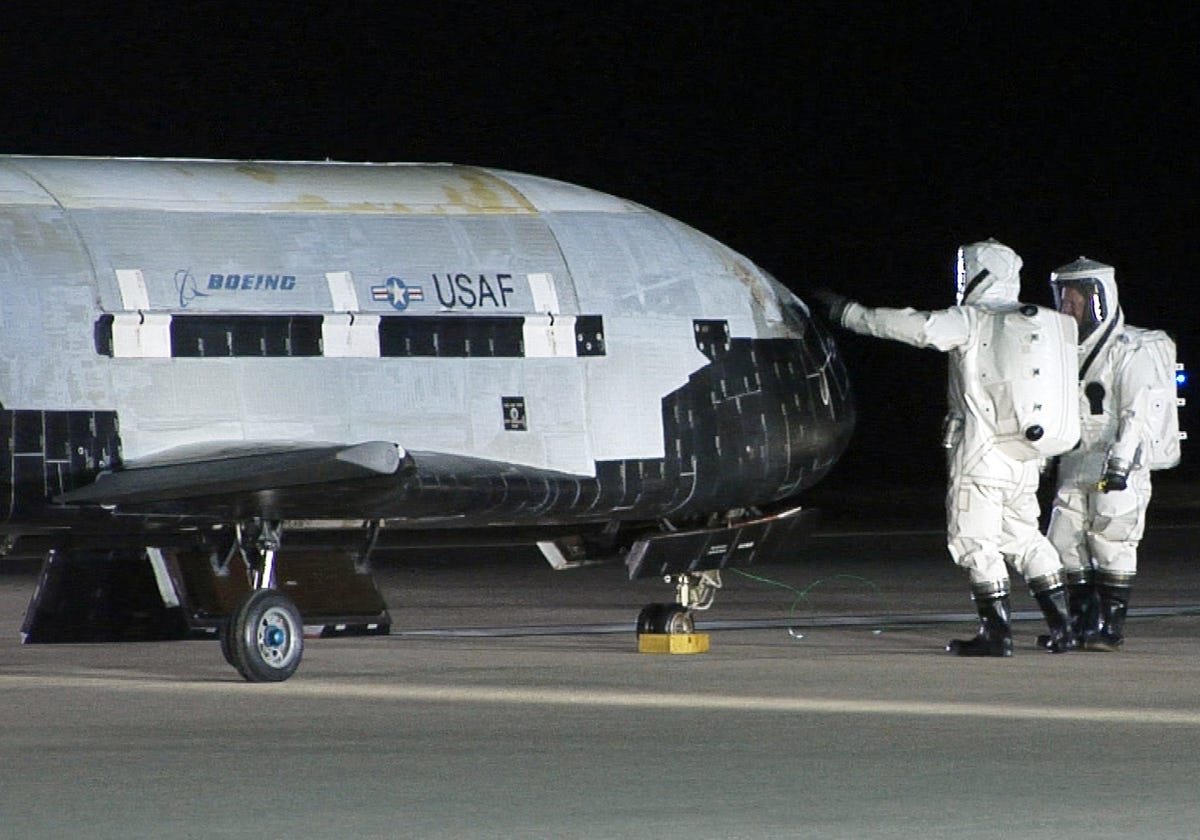
Landings typically occur at Vandenberg (Runway 12) or Kennedy (Runways 15/33), with Edwards Air Force Base as a backup. Post-landing, the vehicle is transported via C-17 aircraft, and crews use protective gear due to residual hypergolic propellants.
Space Operations and Missions
X-37B missions focus on testing reusable technologies, including avionics, flight systems, thermal protection, propulsion, and reentry maneuvers. Operations are highly autonomous, with the vehicle capable of orbit changes, extended stays, and precise landings.
Early flights like OTV-1 demonstrated the first autonomous orbital runway landing. Missions have progressively broken endurance records, with OTV-6 carrying the most payloads, including a service module for expanded experiments, NASA radiation studies, and the deployment of FalconSat-8—a 300-pound satellite with propulsion and antenna tests.
OTV-5 tested the Advanced Structurally Embedded Thermal Spreader II (ASETS-II) for heat management. OTV-7, the first beyond low Earth orbit (LEO), operated in a highly elliptical orbit (apogee over 35,786 km, perigee ~1,000 km), conducting radiation experiments and space domain awareness (SDA) testing.
It pioneered aerobraking—using atmospheric drag to adjust orbit and dispose of the service module responsibly—while tracking 1.7 million collision avoidance opportunities. OTV-8 focuses on laser communications and quantum inertial sensors. Overall, the program has supported over 3,774 days of orbital testing by OTV-6's end, surpassing the Space Shuttle's total, and informs Space Force strategies for resilient architectures and on-orbit servicing.
Controversies and Speculations
The X-37B's classified nature has sparked significant controversy, with much speculation about its true purposes beyond official statements of technology testing. Critics argue its secrecy could escalate space militarization, drawing parallels to Sun Tzu's Art of War principles of deception—feigning capabilities to mislead adversaries like China, potentially forcing them to divert resources to countermeasures or duplicates, such as China's Shenlong spaceplane. Chinese media has labeled it a potential space weapon or bomber, prompting calls for transparency to avoid arms races.
Surveillance: Carrying reconnaissance gear for spying on regions like the Middle East, though fuel limits hinder rapid orbital shifts.
Space Bombing: Acting as an orbital bomber, but experts dismiss this due to high fuel costs for targeting.
Satellite Interference: Disabling enemy satellites, traceable and challenging without detection.
Spying on China's Space Station: Monitoring Tiangong-1, refuted by mismatched orbits.
Deploying Spy Satellites: Releasing small probes, supported by observed flight patterns.
Additional speculations involve weapon development, anti-satellite tech, or exotic propulsion like the EmDrive (later confirmed as Hall-effect thrusters). The Pentagon denies weaponization, but similarities to China's programs raise concerns about orbital bombardment systems. The program's opacity risks unintended escalations, yet it provides strategic advantages in a contested space domain.
Authors note: This is one of the programs that I worked on during my 40 year aerospace career.
I wonder if it can carry/deploy “ DEW’s”?